Monday, April 16, 2012

Jobs Numbers Could Be Due to Skewed Data

John Schoen:
Friday's report showing a sharp hiring slowdown in March lends weight to suspicions that a string of positive monthly reports may have been too good to be true. 
But the disappointing numbers for March may not be as bad as they seem. The problem, say economists, is that unusual weather and seasonal adjustments may have thrown this winter's data out of whack. 
According to the Labor Department's latest monthly survey, employers added just 120,000 jobs in March, well short of the expected pace of more than 200,000 reached in each of the previous three months.  
Despite the lackluster gains, the official unemployment rate fell a notch to 8.2 percent in March, the lowest since January 2009, but only because fewer people were looking for work. 
The economy has added 858,000 jobs since December and 3.5 million over the past two years. But economists have been paring back their forecasts for economic growth in 2012...(Continue Reading)

Sunday, April 15, 2012

Seminar: Real-Time Exchange Rate Predictability with Taylor Rule Fundamentals

Tanya Molodtsova, a diminutive econ Ph.D with a compelling accent, presented the paper Real-Time Exchange Rate Predictability with Taylor Rule Fundamentals at one of our 2pm Friday seminars. At the expense of what I’m sure would be a very interesting social commentary, as I am now convinced all academic functions are (inductive fallacy perhaps), I’ll jump in to the paper and subject matter.

A quick look at the abstract reminds us of the dangers in tightly packed formal language (e.g. slightly dominate)* in addition to getting the gist of the paper without the mind-numbing effect of the more technical sections. It looks for short term/horizon exchange rate predictability using the Taylor Rule and other complicated forecasting methods I’m not familiar with. Another important distinction is that of real-time data and vintage data, the later having been revised in some way and the former being what you might consider raw.

Historically research hasn’t been able to predict change other than a no change hypothesis, i.e. they can’t reject the null hypothesis of 0.** In an attempt not to dig myself an even larger hole of blatant ignorance I’ll quote the conclusions of Molodtsova’s paper.
“In contrast with previous results in literature, the evidence of short-term predictability with (an) asymmetric Taylor rule model in a panel framework is striking. The evidence of out-of-sample predictability is found for 5 out of 10 countries.”
So, good work team!

The most useful item I picked up, from my perspective of complete ignorance, was a cursory understanding of the Taylor rule. It is an item used by central bankers to help target the nominal interest rate (read federal funds rate) and includes things such as inflation and target inflation, output and potential out, and other things that seem to require ghastly assumptions such as the equilibrium real interest rate. Also included for some countries (not the US) is a targeted exchange rate.

*I included sentence interruption specifically because McCloskey thinks its crap and I happen to be quite fond of interrupted sentences.

**At this point let me elaborate on my almost complete ignorance on this topic. I’m an undergrad who has had two legitimately macro oriented classes. This is the first time I’ve been exposed to any type of macro forecasting.

Friday, April 13, 2012

Spencer England on the Employment Situation

From: Angry Bear contributor Spencer England

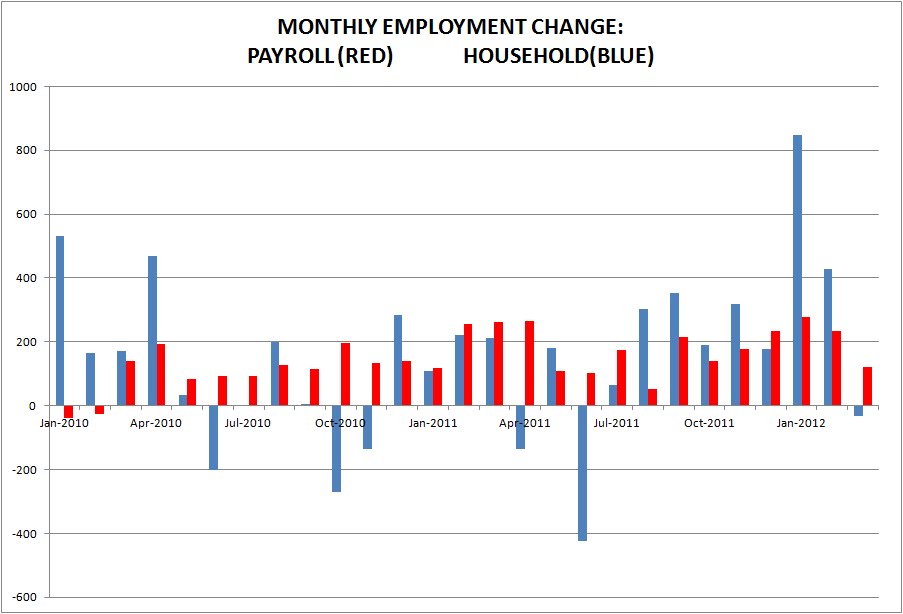
The employment report was a major disappointment. Payroll employment rose some 120,000, significantly less than the over 200,000 anticipated. Moreover, the household survey displayed a -31,000 drop in employment.

The unemployment rate did tick down from 8.3% to 8.2%. But that was largely because the labor force fell -164,000


Moreover, the average work week fell from 34.6 to 34.5 hours so that the index of aggregate hours worked only rose 0.1%.


The index of hours worked has been raising a red flag about the numerous other signs of stronger employment and an acceleration of economic growth. They are not showing the recent improvement that other employment data have been reporting. Recently, unit labor cost has been rising faster than prices, implying margin pressure and very weak profits. To sustain profits growth, firms have to reestablish stronger productivity growth. The weakness in March employment is a strong indicator that business is trying to rebuild productivity growth and profits growth.


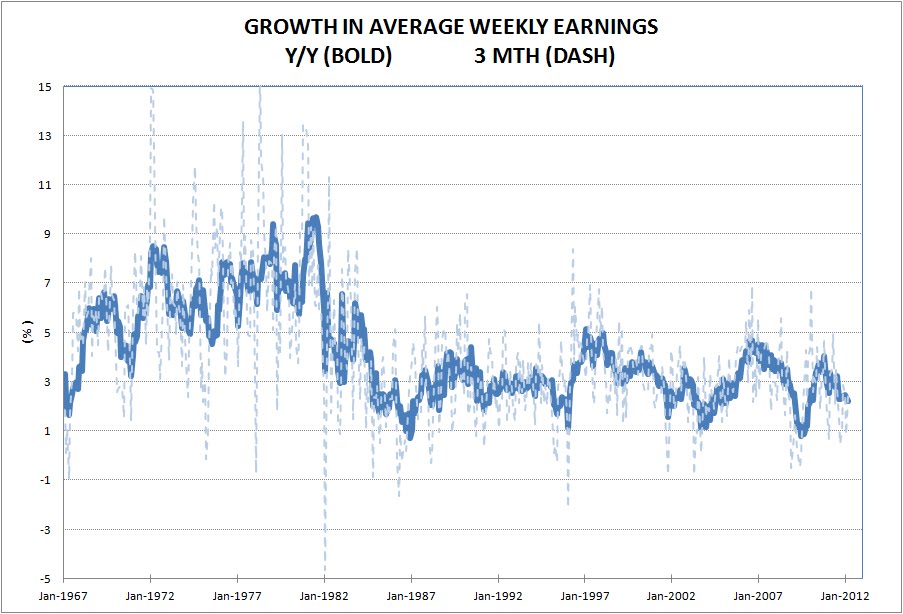
Average hourly earnings only rose from $23.34 to $23.39 so average hourly earnings continued to slow. The year over year gain is now only 1.7%, a new record low. Moreover, weekly earnings growth slowed to only 2.2%. The recent improvement in retail sales had been driven largely by a decline in consumer savings and their are serious questions about how long this could be sustained.


No wonder Bernanke is reluctant to end quantitative easing despite political pressure and Taylor rule type indicators suggesting that fed funds should be raised.


The March unemployment numbers suggest that economic growth is still stagnant despite the slight 0.1% drop in the unemployment figure. In this analysis, Spencer England from Angry Bear dives into some of the reasons why the drop in unemployment isn't necessarily something to celebrate.  He starts out by stating that the main reason for the drop in unemployment was caused by a 164,000 person drop in the labor force, and then begins to dive even further into why the numbers are highly disappointing.  One important red flag that England describes is the index of hours worked.  They are showing that labor costs have been rising faster than prices; indicating that profit margins have been steadily decreasing.  As long as employers need to increase productivity growth and profit margins unemployment will remain quite high.  

Interpreting The Head Scratching Unemployment Claims Data

Lee Adler:
Actual, not seasonally adjusted, initial unemployment claims totaled 319,349 last week, according to the Department of Labor tabulation of weekly data submitted to it by the 50 state employment departments. This number was virtually unchanged from the prior week total of 319,382. As always, the media reported only the seasonally manipulated numbers showing a decline of 5,000 claims to 359,000. And that left them scratching their heads because of a major revision of 5 years worth of seasonally adjusted crap data.
...............
The good news is that the actual data is the actual data. It doesn’t change because of some ever changing seasonal hocus pocus factor that results in 5 years worth of data revisions that still do not accurately reflect reality. I analyze only the actual data, which is the data that everyone should be focused on. The government reports it. The mainstream media and the economic punditry ignore it. It’s no wonder that their guesstimates have all the accuracy of a coin flip.
...............
Looking at the big picture, the trend rate of decline in first time claims has consistently been around 10% for the past 18 months. There’s no sign of any change in that rate, suggesting that the economy remains in a slow growth path, shedding far fewer jobs than during the 2008-2009 collapse.
As with the Molodtsova paper the distinction between real-time and current vintage data can have a significant impact on the interpretation of that data. To get a clear view of what actually just occurred a look at numbers without mysterious seasonal adjustment factors can yield more clear comparisons between current and historical data. The conclusions are particularly encouraging, but neither are they much of a surprise.    

Read at The Wall Street Examiner

The Federal Reserve's Utter Policy Failure

Karl Smith:
While central banks can -- and have -- stabilized things, there is little they can do on their own to engineer the fundamental realignments that must accommodate seven specific dynamics in advanced economies (something that we will come back to later in discussing the way forward):
  • Accommodating the "safe" debt de-leveraging of the private sector by enabling high sustained growth
  • Safely de-risking the financial sector
  • Clearing or replacing clogged credit pipes
  • Achieving a sustainable trajectory for public finances
  • Improving the functioning of the labor market
  • Compensating for inadequate past investments in human resources, productive capacity and infrastructure
  • Adjusting to the ongoing developmental breakout phase in several systemically important emerging countries (including Brazil, China, India, and Indonesia).
To be effective, central banks in advanced economies needed -- and need -- help from other policymaking entities to deal with the twin unfortunate realities of too much debt and too little growth. They must be assisted with the engagement of the healthy balance sheets around the world, and fortunately there are quite a few of them in both the public and private sectors. And this must be done in an internationally coordinated fashion in order to accommodate the new global realities.
I thought this blog post made an interesting point about how the main function of macro policy is to balance maximum employment against stable prices, not necessarily facilitate growth.

The Federal Reserve's Utter Policy Failure

Could bold action be what the housing market needs?

Sudeep Reddy:
The IMF, in a section of its World Economic Outlook released Tuesday, called for “bold” policies around the world to cut household mortgage debt in the wake of falling home prices. Among the successes it highlighted: Iceland during the recent recession and the U.S. in the 1930s, when the Home Owners’ Loan Corporation instituted “a bold and broadly successful” government-backed debt-restructuring program designed to prevent foreclosures. The government’s HOLC was launched in 1933 “because a series of earlier initiatives designed to stop the rising number of foreclosures had achieved little,” the IMF said in the study. Still, the HOLC “got off to a rough start: it underestimated the size of the task and was poorly organized,” the IMF said. In addition, “the lack of precedent and the urgency of the situation posed challenges.”
Sound familiar? The Obama administration has tried since its earliest months in 2009 to fight a persistent housing decline. Its programs, designed to cut mortgage debt and ease the burden on households, have struggled to gain traction against political opposition. At the end of 2011, 2.4 million U.S. properties were in foreclosure with more on the horizon. About 951,000 mortgages had been modified permanently, less than 2% of all mortgages.
Some policymakers, and plenty of outside economists, have urged the U.S. to consider a more aggressive housing program on the scale of the 1930s effort. The Depression-era program, launched in 1933 eight years after home prices peaked, modified about 20% of mortgages.
The HOLC bought distressed mortgages from lenders, issued government-backed bonds in exchange, then restructured the mortgages by working with borrowers. It bought 1 million distressed mortgages — about a fifth of all of mortgages — and faced about 200,00 foreclosures after the renegotiation. But it helped the overall economy, the IMF concluded.
Although such an action would surely have a positive impact on the US economy, I highly doubt policymakers have the willpower to do anything bolder than what has already been done.  It could definitely mean a step in the right direction and could further strengthen the global recovery.

Consumer Sentiment Falls

U.S. consumers in early April felt more cautious about the current economy, according to data released Friday.

The Thomson Reuters/University of Michigan consumer sentiment index in early April stood at 75.7, compared to 76.2 at the end of March and a preliminary March reading of 74.3, according to an economist who has seen the report.

Economists surveyed by Dow Jones Newswires had expected the preliminary April reading to remain at 76.2.

The drop was centered in how consumers feel about the current economy. The current conditions index dropped to 80.6 from 86 at the end of March, while the expectations index improved to 72.5 from 69.8.
The current conditions reading was the lowest since December 2011, while the expectations index was the highest since September 2009.

Sentiment about the economy is being pulled in different directions. High gasoline prices are hurting sentiment, while a rising stock market in the first quarter lifted sentiment among households with equity investments.
Consumers are also dealing with news that the labor markets are not as strong as hoped. A week ago, the Labor Department reported job growth slowed sharply in March. Also, jobless claims jumped to 380,000 in the week ended April 7, the highest level since the end of January.

Within the Thomson Reuters/University of Michigan survey, the one-year inflation expectations reading fell to 3.4%, from 3.9% in late March. The inflation expectations covering the next five to 10 years remained at 3%.

Consumer expectations about the future seem to remain high.  Maybe this is because it's a political year and consumers expect our government to handle the strong hold of high gas prices, give us a balanced budget, and have some major bipartisanship.  Doubtful this is what their thinking!  Maybe its the old saying, "Hope for the best, expect the worse!".  But even this doesn't hold up because based on the consumer sentiment index consumers are expecting better for the future.  It's the present that people are unsure and wary about.  With crippling high gas prices, an extremely slow real estate market recovery (even with small glimpses of hope), and a highly unproductive government, what is there not to be worried about today.  I wasn't involved with the results of the CSI but I can agree all the way.  It's not tomorrow that I'm worried about, IT'S TODAY!  In the long run, I can make changes in spending habits, consumer mindset, and savings.  But in the short run, I'm being hit from every angle.